
news
Why Past Lottery Results Do Not Predict Future Draws
Learn how independent draws work, why frequency charts can mislead, and how to use historical lottery results for description, not prediction.
Past lottery results can show exactly what happened in earlier drawings, but they cannot forecast the outcome of the next properly conducted draw. Each drawing is designed to be independent, meaning earlier results do not make a number more or less likely to appear solely because of its history.
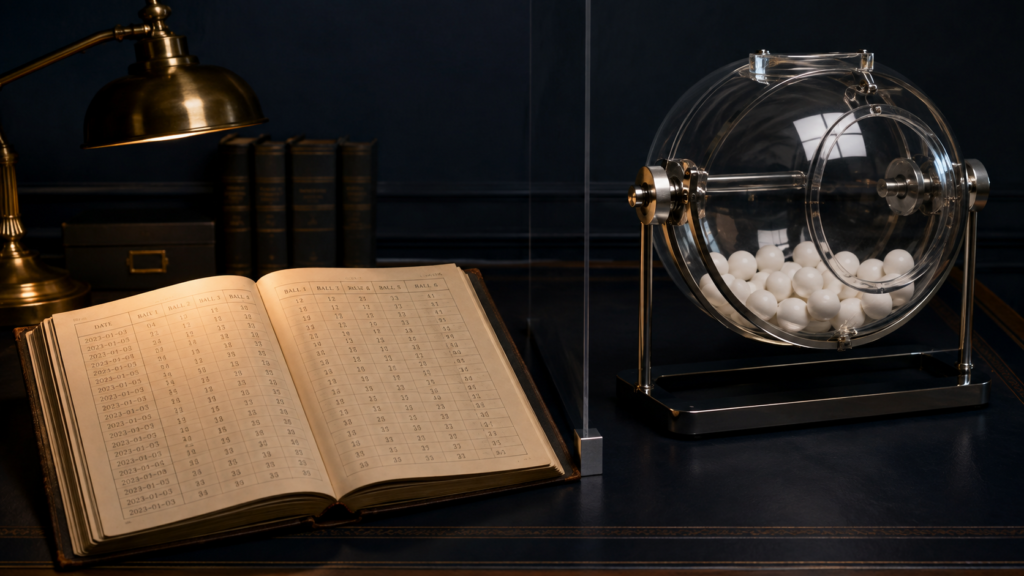
This distinction is important when viewing frequency charts, lists of recent results, or long-term archives. These resources can support verification, transparency, and descriptive analysis. They summarize recorded outcomes; they do not reveal what will happen next.
What independence means
Independence means that the outcome of one drawing does not determine the outcome of a later drawing. A past result may be part of the public record, but it does not carry influence into the next properly conducted draw.
Suppose an archive shows that one number appeared several times in a recent sample, while another did not appear at all. Those observations describe the sample. They do not mean the frequently appearing number has become more likely to appear again, and they do not mean the absent number is now more likely because it is “due.”
The same principle applies whether a person reviews a short list of results or a much longer archive. More historical information can provide a broader description of the past, but it does not change the independence of the next drawing.
This is why claims that a streak, gap, or repeated result guarantees or improves a future outcome are misleading. The history may be accurately recorded, yet the conclusion drawn from it may still be incorrect.
Why frequency charts can be misunderstood
A frequency chart counts how often particular outcomes appeared in a selected group of past drawings. It can answer a historical question such as, “How many times did this number appear in the sample?” It cannot answer the predictive question, “Which number will appear next?”
For a plain-language example, imagine that a results archive contains ten past drawings. One number appears four times, and another appears zero times. The first can be described as more frequent within those ten results. The second can be described as absent from that sample.
Neither description changes what independence means. The number that appeared four times is not made more likely or less likely in the next draw solely by those appearances. Likewise, the number that appeared zero times does not gain a special advantage merely because it has been missing.
Misunderstanding often begins when a factual count is treated as a forecast. Labels such as “frequent,” “rare,” or “not recently seen” refer to the selected historical period. They do not establish what a future drawing will produce.
Useful ways to read a results archive
Historical archives have legitimate uses that do not depend on predicting future outcomes. They provide a record that readers can examine and summarize.
- Verification: An archive can help readers review recorded results from earlier drawings.
- Transparency: A documented history makes past draw information available for examination.
- Descriptive analysis: Readers can count appearances, identify repeated outcomes, or summarize a chosen period.
These uses all look backward. They concern what was recorded, how often something occurred in a defined sample, or whether information has been represented accurately. None turns an archive into a prediction method.
The boundaries of the selected sample also matter to its description. A chart based on one group of past results may show different counts from a chart based on another group. Both may correctly summarize their respective samples without providing a forecast.
When result details are important, readers should check them with the relevant official operator. An archive or summary is most useful when treated as a record of past information rather than evidence of a future result.
Description is not prediction
Descriptive statistics organize and summarize information that already exists. A count, frequency, or list of recent outcomes can make a historical record easier to understand. Its conclusion is limited to the observations included in that record.
Prediction makes a different kind of claim: it attempts to state what will happen later. Past frequencies alone cannot support that claim for an independent future draw. A historical pattern can be real as a description and still have no predictive power.
For example, the statement “this number appeared several times in the selected archive” may be a valid summary. Changing it to “this number should appear next” adds a forecast that the archive does not establish. The same problem occurs when an absence is interpreted as proof that a number must soon appear.
Careful reading therefore requires separating the recorded fact from the added interpretation. Frequency charts and archives can answer questions about the past, but claims that those patterns guarantee or improve future results are misleading.
Takeaway: Past results are useful records, not forecasts. In a properly conducted independent draw, earlier appearances or absences do not change a number’s future likelihood solely because of that history.
Frequently asked questions
Does a frequently appearing number become more likely in the next draw?
No. In a properly conducted independent draw, a number does not become more or less likely solely because it appeared often in a past sample.
Is a number more likely when it has not appeared recently?
No. A past absence describes the selected historical sample, but it does not make the number more likely in the next independent draw.
What are historical lottery archives useful for?
Historical archives are useful for verification, transparency, and descriptive analysis. They summarize what happened but do not predict the next result.
Can a past pattern guarantee a future result?
No. Claims that past patterns guarantee or improve future results are misleading because properly conducted drawings are designed to be independent.